What Is “Cell Secret”? Understanding an Emerging Biotechnology Term and Key Quality Indicators

  • 2026-06-23


Cell Secret education and biotechnology information literacy
 
SCIENCE LITERACY & BEAUTY EDUCATION
What Is “Cell Secret”?
Understanding an Emerging Biotechnology Term
Build sound scientific literacy by examining terminology, raw material sources, manufacturing processes, and testing methods.
Start Reading  ›
WHY THIS TERM MATTERS
Why Is It Important to Understand “Cell Secret” Correctly?
In recent years, beauty, biotechnology, and health-related content has increasingly featured new terms associated with microvesicles, encapsulation, delivery, and carriers.

These terms often sound highly technical and can easily lead readers to assume specific functions. The faster new terminology appears, the more important it becomes to clarify whether the term is formally recognized in science, whether different sources refer to the same type of material, and whether the claims are supported by sufficient evidence.
Key focus: This article explains how the term “Cell Secret” is commonly used in beauty and biotechnology content, and outlines how to evaluate terminology, sources, manufacturing processes, particle counts, and testing data.
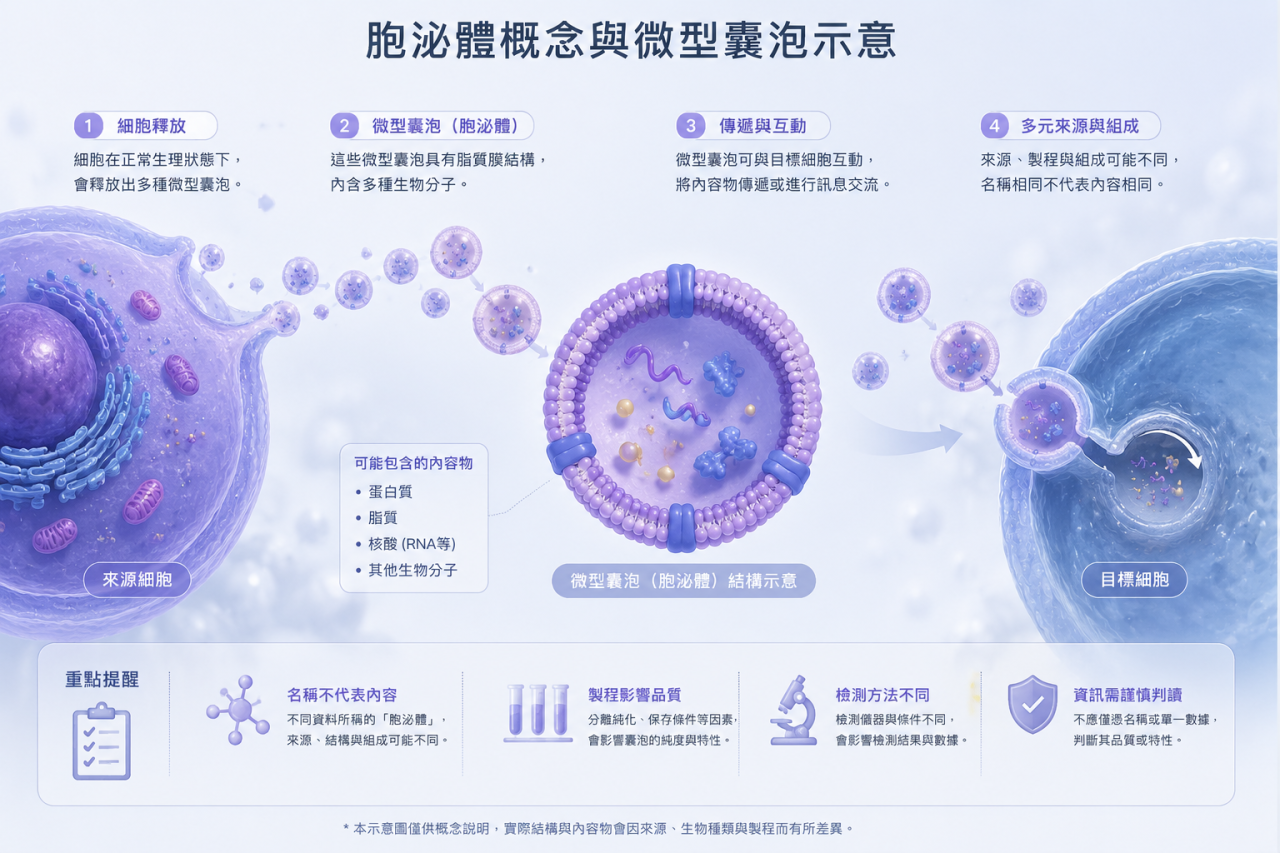
Conceptual illustration of Cell Secret and microvesicles
UNDERSTANDING THE TERM
What Exactly Is “Cell Secret”?
“Cell Secret” is not currently a formally recognized term in standard biological classification. It is a name used in some beauty, biotechnology, and marketing contexts.

Different sources may use the term to describe materials with different origins, structures, sources, and manufacturing processes. Therefore, the actual content cannot be determined from the name alone.
The name may bring to mind microvesicles, membrane structures, encapsulated ingredients, or particulate carriers. However, this does not mean that all materials described as “Cell Secret” share the same structure, composition, or characteristics.
A NAME IS ONLY THE START
Why Can’t the Name Alone Define the Actual Material?
01
Different Raw Material Sources
Different biological materials, culture sources, or preparation systems may result in different raw material characteristics.
02
Different Manufacturing Processes
Isolation, filtration, purification, concentration, and storage methods may all affect the final material.
03
Different Compositions
Even when appearance or particle size is similar, the actual lipid, protein, and other material content may differ.
04
Different Quality Specifications
Testing methods, purity, contamination control, and batch-to-batch consistency are all important indicators of quality.
A technical name is only the starting point for understanding; it is not proof of quality or effectiveness.
MORE THAN A NUMBER
Why Shouldn’t We Look Only at Particle Count?
Particle count only reflects the quantity observed under specific testing conditions. By itself, it cannot prove particle identity, purity, composition, stability, or any specific effect.
Testing Equipment
Different instruments may produce different data.
Sample Concentration
Sample dilution and concentration settings can affect test results.
Particle Size Distribution
A single average value cannot fully represent the overall sample.
Storage Conditions
Temperature, time, and storage environment may all affect stability.
Purification Method
Different isolation and purification procedures may affect sample purity.
Batch Consistency
A single test result may not represent every batch of material.
Quantity can describe a sample, but it cannot define quality on its own.
ENCAPSULATION & CARRIER CONCEPTS
How Should We Understand “Encapsulation” and “Carriers”?
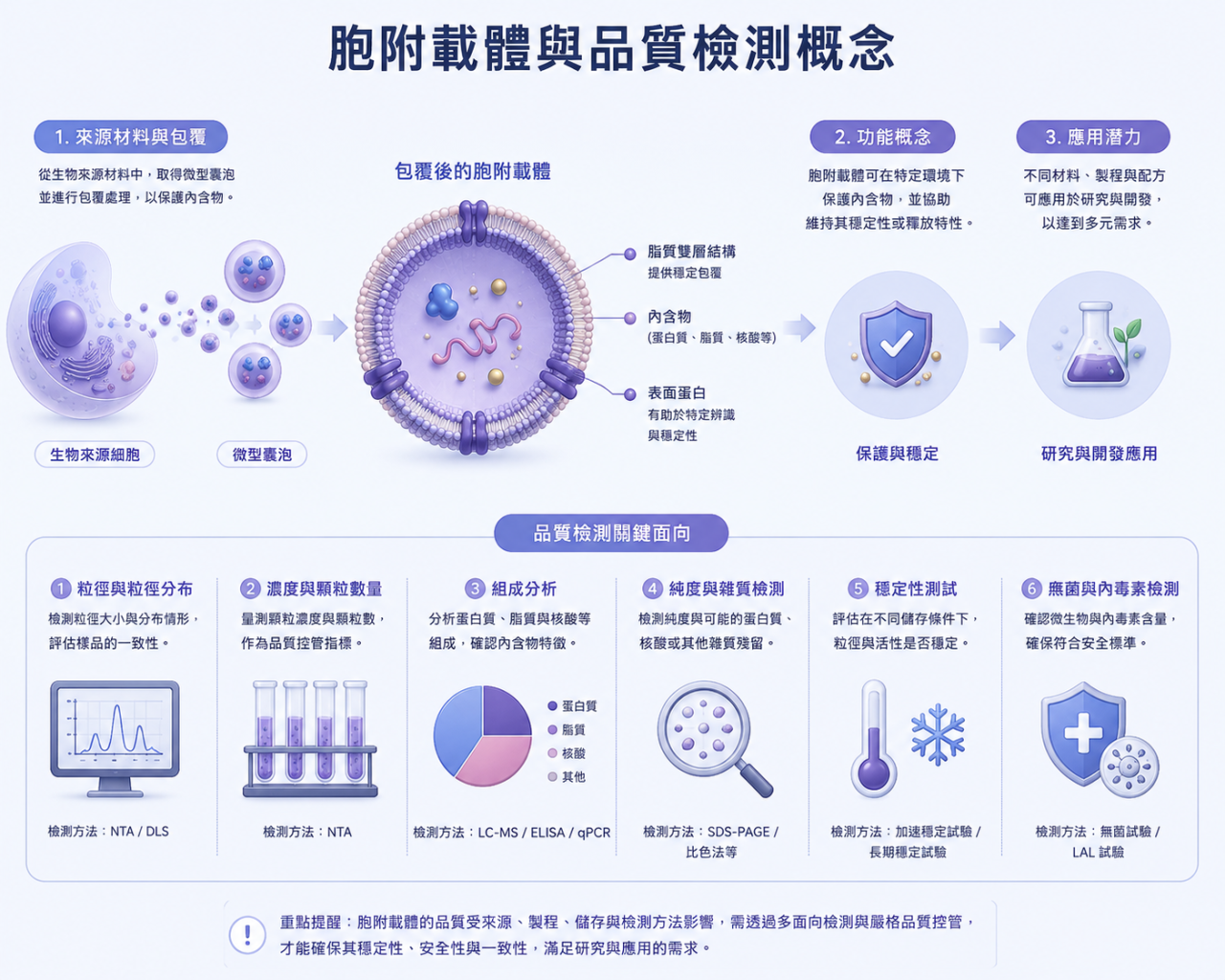
In materials science, biotechnology, and formulation research, encapsulation or carrier systems are often used to protect specific substances, improve stability, or help researchers control storage and release behavior.

Whether a material actually has encapsulation, carrier, or release properties must be determined from its structure, manufacturing process, and experimental data. These properties cannot be assumed simply because the term “Cell Secret” is used.
Concept of encapsulated carriers and quality testing
WHY WE SHOULD UNDERSTAND IT
Why Is “Cell Secret” Worth Understanding?
“Cell Secret” is worth understanding not because the term sounds advanced, but because emerging terminology can create information gaps.

When scientific language, marketing terms, particle numbers, and research concepts are mixed together, consumers need to learn how to verify definitions, raw material sources, manufacturing processes, testing methods, and the completeness of supporting data.
The importance of “Cell Secret” does not lie in the name itself, but in whether we clearly understand what it actually represents.
FIVE CHECKPOINTS
How Should We Evaluate Information About “Cell Secret”?
1
Start with the Definition
Check whether the source clearly explains what “Cell Secret” means in that specific context.
2
Review the Raw Material Source
Confirm whether the source, manufacturing method, and basic specifications are disclosed.
3
Review the Testing Methods
Find out how particle count, particle size, and composition were measured.
4
Distinguish Research from Real-World Use
Avoid treating research findings as guaranteed real-world effects.
5
Watch for Absolute Claims
When terms such as “precise,” “activate,” “reverse,” or “regenerate” appear, check whether they are supported by appropriate evidence.
FREQUENTLY ASKED QUESTIONS
Frequently Asked Questions About “Cell Secret”
Is “Cell Secret” a Formal Scientific Classification?
At present, it is not a formally recognized term in standard biological classification. Different sources may use the name to refer to different concepts or materials, so the specific definition and specifications provided by each source should be reviewed.
Does the Same Name Mean the Material Is Always the Same?
Not necessarily. Differences in source, manufacturing process, purification method, composition, storage, and testing methods may all lead to different results.
Is a Higher Particle Count Always Better?
Particle count alone is not enough. Particle identity, purity, size distribution, testing method, and batch consistency are equally important.
Does “Cell Secret” Always Have Encapsulation or Delivery Functions?
These functions cannot be assumed from the name alone. Any specific structure or property must be evaluated using data for the individual material.
What Is the Most Important Thing to Check When Reading About “Cell Secret”?
First confirm how the term is defined, then review the source, manufacturing process, quality specifications, and testing methods. Do not judge the material based only on a name or a single number.
PROFESSIONAL CONCLUSION
Understanding the Term
Matters More Than Chasing the Trend
As technology continues to advance, new terms will continue to appear. “Cell Secret” is worth understanding not because it guarantees a particular outcome, but because it reminds us to examine the raw materials, manufacturing processes, testing methods, and evidence behind biotechnology and beauty-related information.

Truly professional scientific communication does not exaggerate unfamiliar terminology. It makes complex concepts transparent, understandable, and verifiable.
This article is intended for general scientific and beauty information literacy. It explains market terminology and principles for evaluating information. It does not assess the effectiveness of any product, raw material, or brand, and it is not intended for disease diagnosis or treatment.